what cpt code is assigned to an ed service that has a detailed history and exam
What Are E/M Codes?

Evaluation and management (East/M) coding is the utilise of CPT® codes from the range 99202-99499 to stand for services provided by a physician or other qualified healthcare professional person. Equally the name East/Thousand indicates, these medical codes use to visits and services that involve evaluating and managing patient health.
Examples of E/M services include office visits, infirmary visits, habitation services, and preventive medicine services. Codes for services similar surgeries and radiologic imaging are establish outside of the E/One thousand section of the CPT® code ready.
Medicare, Medicaid, and other third-political party payers accept E/M codes on claims that physicians and other qualified healthcare professionals submit to request reimbursement for their professional services. E/M service codes also may be used to nib for outpatient facility services. Facilities and practices may use E/K codes internally, as well, to assist with tracking and analyzing the services they provide.
Due east/G services are high-volume services. Even small E/M coding mistakes can cause major compliance and payment issues if the errors are repeated on a large number of claims. To ensure accurate reporting and reimbursement for these services, those involved in the coding process demand to stay up to engagement on Due east/M coding rules. An important area to picket is that the Centers for Medicare & Medicaid Services (CMS) and the American Medical Association (AMA) implemented major changes for function/outpatient E/One thousand coding and documentation rules in 2021, and experts expect other E/Thousand sections volition see similar changes in the futurity.
What a Typical E/M Code Looks Like
CPT® is an abbreviation for Current Procedural Terminology, a set of five-character medical codes maintained by the AMA. Evaluation and Management Services is one department in the CPT® code set. Other sections in the CPT® code set include Anesthesia, Surgery, Radiology Procedures, Pathology and Laboratory Procedures, and Medicine Services and Procedures.
CPT® includes more than two dozen categories of Due east/Thousand codes, from office and other outpatient services to advance care planning. Y'all may find further divisions within each category, such equally carve up options for new patients and established patients.
The CPT® code set up uses the same basic format to draw the E/Chiliad service levels for many (simply not all) categories:
- A unique lawmaking, such as 99235
- The place and/or type of service, such as observation or inpatient hospital care
- The service'due south content, such as a comprehensive history, a comprehensive examination, and medical decision making (MDM) of moderate complexity
- The nature of the presenting trouble or bug usually associated with a given level, such every bit moderate severity; and
- The time usually associated with the service, such as l minutes at the bedside and on the patient's infirmary floor
When you bring that all together, it looks like this case lawmaking with the official descriptor shown in italics: 99235 Ascertainment or inpatient hospital intendance, for the evaluation and management of a patient including admission and discharge on the same date, which requires these iii key components: A comprehensive history; A comprehensive examination; and Medical determination making of moderate complexity. Counseling and/or coordination of care with other physicians, other qualified wellness intendance professionals, or agencies are provided consequent with the nature of the problem(s) and the patient'due south and/or family's needs. Usually the presenting problem(due south) requiring admission are of moderate severity. Typically, 50 minutes are spent at the bedside and on the patient's hospital floor or unit of measurement.
Every bit noted above, CPT® revised office and other outpatient E/Yard codes 99202-99215 in 2021. Most of those codes' descriptors at present follow a template of listing the setting, whether the patient is new or established, the level of medical decision making, and the full fourth dimension spent on the run into date. An example is 99213 Office or other outpatient visit for the evaluation and management of an established patient, which requires a medically advisable history and/or test and low level of medical decision making. When using time for code selection, 20-29 minutes of total fourth dimension is spent on the date of the encounter.
CPT® and Medicare E/Chiliad Documentation Guidelines
E/Thou coding tin exist difficult because of the factors involved in selecting the correct code. For example, many E/One thousand codes require the coder to make up one's mind the type of history, examination, and medical decision making, which can involve using special grids and tables to bank check requirements.
The AMA CPT® code set includes E/M guidelines, but CMS has besides published more than specific guidance on proper Eastward/M coding and documentation. About notably, CMS issued the 1995 Eastward/M Documentation Guidelines and the 1997 Documentation Guidelines to assist providers and medical coders distinguish the various East/Thou service levels. Both the 1995 and 1997 Eastward/M Documentation guidelines from CMS are all the same in use. Many third-party payers likewise apply these guidelines.
This article references CPT® E/Thou section guidelines and CMS 1995 and 1997 Documentation Guidelines considering all are of import to proper coding of Due east/M services. Note, however, that because of the 2021 updates to role/outpatient E/M coding, the 1995 and 1997 Documentation Guidelines no longer use to CPT® codes 99202-99215.
Usually Used E/M Terms
When you're reviewing E/G rules and regulations, you'll see certain terms oftentimes. Below are definitions to assist you understand E/M terminology.
A qualified healthcare professional person is "an individual who is qualified by teaching, training, licensure/regulation (when applicative), and facility privileging (when applicable) who performs a professional service within his or her scope of practice and independently reports that professional person service," according to CPT® guidelines. East/1000 code descriptors and rules frequently refer to "physicians and other qualified health care professionals." This may include advanced practice nurses (APNs) and physician assistants (PAs). Clinical staff members practice not fall in this category.
A clinical staff member is "a person who works under the supervision of a doc or other qualified health intendance professional, and who is allowed by constabulary, regulation, and facility policy to perform or help in the operation of a specific professional service, but does not individually study that professional service," CPT® guidelines state.
A professional service is a confront-to-face service by a md or other qualified healthcare professional who can study E/Thou codes. This definition of a professional service is specific to East/M coding for distinguishing betwixt new and established patients.
A new patient is a patient who has not received any professional services (remember, that ways face-to-face services) within the past three years from the doctor or qualified healthcare professional providing the electric current Due east/One thousand service, or from another doc or qualified healthcare professional person of the same specialty and subspecialty who is function of the same group practice. That's the definition of new patient according to AMA CPT® E/M guidelines. Medicare refers only to the same doctor specialty (not subspecialty) in its definition of new patient for E/M coding, available in Medicare Claims Processing Transmission, Chapter 12, Section xxx.6.7.A. Physicians self-designate their Medicare specialty when they enroll, choosing from the list of specialty codes in Medicare Claims Processing Manual, Affiliate 26, Section ten.viii.ii.
- The following is an example of a new patient East/Chiliad visit demonstrating the professional person services rule: A 65-twelvemonth-quondam male sees a cardiologist for an E/G service. Another cardiologist in the practise provided an interpretation of an EKG for the aforementioned patient the previous year when he was in the emergency section, but at that place was no face-to-face service. In this case, the cardiologist providing the E/M can still consider the patient to be new for E/M coding purposes because no cardiologist in the practice provided the patient with a face-to-face service within the past three years.
- The following is an case of a new patient E/M visit demonstrating the same-specialty dominion: A patient has been seeing an internist in a multispecialty group for the past three years for primary intendance, particularly hypertension. The internist identified some suspicious lesions and sent the patient to a general surgeon in the same practice to evaluate lesion removal. The patient is a new patient to the full general surgeon because the surgeon has a unlike specialty than the internist.
An established patient is a patient who has received professional (face-to-face) services within the past 3 years from the doctor or qualified healthcare professional providing the E/M, or from some other doc or qualified healthcare professional of the same specialty (and subspecialty, says AMA) who is part of the aforementioned group practice.
- following is an example of an established patient E/M visit demonstrating the aforementioned-subspecialty rule: A pediatric patient comes to an function lament of tum pains. Although this is the pediatric gastroenterologist's first time meeting the patient, another doctor of the same subspecialty in the aforementioned group practice saw the patient ii years ago for a similar complaint. In this example, y'all should consider the patient to exist established.
Scenarios for determining whether a patient is new or established can get complicated. The CPT® guidelines provide this additional guidance:
- When a physician or qualified healthcare professional is on-call or covering for another provider, CPT® guidelines instruct you lot to classify the patient meet equally new or established based on the patient's relationship to the unavailable provider.
- When an APN or PA works with a physician, the CPT® E/M guidelines state y'all should consider the APN or PA to exist the same specialty and subspecialty as the physician.
- If your do has multiple locations and a provider in location A sees the patient in year i and and so a same-subspecialty doctor at location B sees the patient in year two, consider the patient to exist established. The unlike location is not a factor in determining whether the patient is new or established.
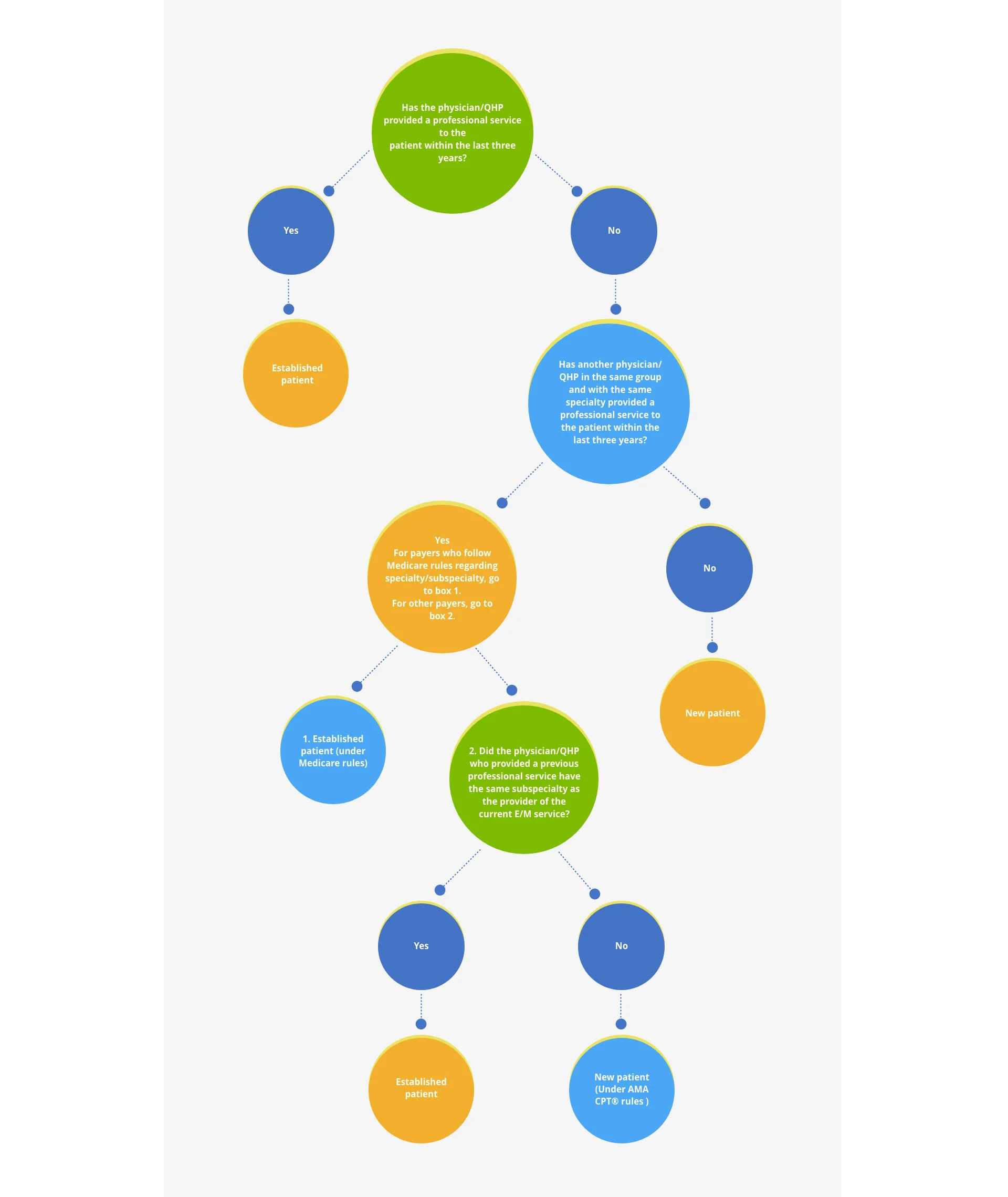
The definitions of new patient and established patient for E/M coding are dense because in that location are and so many elements involved. The decision tree beneath will help you determine whether a patient is new or established for an East/M see. The term QHP used in the graphic stands for qualified healthcare professional.
E/1000 Conclusion Tree: New vs. Established Patient
Components of East/M Service Levels
At that place are oft three to five E/M service levels within each E/M code category or subcategory. Each level has its ain Eastward/1000 code. The intent behind the dissimilar levels of East/G services is to represent the variations in skills, knowledge, and work required for dissimilar encounters.
At that place are seven components used in the descriptors of many Due east/M codes, according to the CPT® Due east/G guidelines section "Guidelines for Hospital Observation, Hospital Inpatient, Consultations, Emergency Section, Nursing Facility, Domiciliary, Rest Habitation, or Custodial Care, and Home E/M Services." The starting time three are chosen central components for E/Thousand level pick.
- ane. History
- 2. Examination
- 3. Medical decision making (MDM)
The next three elements are called contributory factors. The get-go ii are important, simply they aren't required or relevant for every run into.
- 4. Counseling
- v. Coordination of care
- 6. Nature of presenting problem
In that location is 1 terminal component for East/M services, which you lot may use to determine the appropriate code level.
- 7. Time
The time component does not apply to all Eastward/G codes. For example, you should non consider time to exist a component for emergency section (ED) E/M services. Most ED services are provided in a setting where multiple patients are seen during the aforementioned time period, and information technology would be difficult to calculate time for whatsoever i patient. You can read more virtually the time component of Due east/M later in this article.
The component requirements for 2 East/K codes that are the same level may not be the same, so review each descriptor carefully earlier you make your final code choice.
Table one provides an example of how the Due east/M component requirements may vary between two codes even when those codes are both level-i codes.
Tabular array 1: Comparing of E/Thousand Component Requirements for 99221 and 99231
| Lawmaking | 99221 (Level-one initial hospital care) | 99231 (Level-one subsequent hospital care) |
|---|---|---|
| Number of key components required | All three components | At least two of three components |
| History | Detailed or comprehensive | Problem focused, interval type |
| Exam | Detailed or comprehensive | Problem focused |
| MDM | Straightforward or low complication | |
| Counseling | Consistent with the nature of the trouble(s) and the patient'due south and/or family's needs | |
| Coordination of care | ||
| Presenting Problem | Low severity | Stable, recovering, or improving |
| Fourth dimension | 30 minutes at bedside or on patient's floor/unit | 15 minutes at bedside or on patient's flooring/unit |
For office and other outpatient E/Grand services 99202-99205 and 99212-99215, your code choice is non based on the seven components listed in a higher place. Instead, you lot make your code choice based simply on the MDM level or the full time. Office and outpatient encounters are notwithstanding likely to include some or all of the other components, nevertheless, and the provider should document the encounter completely, even for components that practice non drive code pick.
Number of Key Components Required for E/Chiliad Code
When selecting Eastward/M lawmaking level based on the 3 fundamental components of history, exam, and MDM, pay attention to whether the code requires yous to meet the stated levels for three out of three or two out of 3 key components.
As an case, in Tabular array i you saw that initial infirmary visit lawmaking 99221 requires all 3 components, just subsequent hospital visit code 99231 requires only 2 of the three components. Many of the codes requiring three of three components are for new patients or initial services, and many of the codes requiring ii of 3 components are for established patients and subsequent services.
Yous must meet or exceed requirements stated in the code descriptor for three out of three key components for the types of E/M codes listed below:
- Initial ascertainment services
- Initial hospital inpatient care services
- Observation/inpatient hospital care that includes access and discharge services on the same date
- Office consultation services
- Inpatient consultation services
- Emergency department services
- Initial and sure other nursing facility services
- New patient domiciliary, rest home (due east.g., boarding dwelling), or custodial intendance services
- New patient habitation services
You lot need to meet requirements for simply two out of the three key components for these E/M services:
- Subsequent observation care
- Subsequent hospital intendance
- Subsequent nursing facility care
- Established patient domiciliary, rest home (e.g., boarding home), or custodial intendance services
- Established patient home services
Many of these E/One thousand codes also include an option to select the level based on fourth dimension in certain circumstances. Yous'll larn more most coding E/Thousand based on fourth dimension later in this commodity.
Examples of E/M Coding Based on Cardinal Components
Beneath are examples of meeting three of three and two of three fundamental components for E/1000 coding. Call up that the fundamental components for Eastward/M coding are history, exam, and MDM. At that place are different types (levels) of each component, and a quick await at these types volition help you empathise the examples.
These are the four types of history in East/Yard coding, from everyman to highest:
- Problem focused
- Expanded problem focused
- Detailed
- Comprehensive
CPT® East/M guidelines list four types of examination, as well. The terms used for examination blazon are the same as those used for history type:
- Problem focused
- Expanded problem focused
- Detailed
- Comprehensive
There are also four types of MDM, shown here from lowest to highest:
- Straightforward
- Depression complexity
- Moderate complexity
- High complexity
Allow's start with an example of a new patient rest home visit. For new patient rest home visit E/Chiliad codes that require you to meet or exceed iii out of three primal components (99324-99328), y'all accept to code based on the lowest level component from the encounter.
Suppose a visit included a comprehensive history, an expanded problem focused examination, and MDM of moderate complexity. You must choose your code based on the lowest documented component considering you take to encounter (or exceed) the requirements for all three components. The everyman component in our example is the expanded problem focused exam, as shown beneath in Table two.
Tabular array 2: New Patient Rest Dwelling E/1000 Example
| Component | History | Exam | MDM |
|---|---|---|---|
| Lowest Highest | Problem focused | Problem focused | Straightforward |
| Expanded problem focused | Expanded problem focused | Low complexity | |
| Detailed | Detailed | Moderate complexity | |
| Comprehensive | Comprehensive | High Complication |
The correct code in this case is 99325 Domicilic or rest habitation visit for the evaluation and management of a new patient, which requires these iii key components: An expanded problem focused history; An expanded problem focused examination; Medical determination making of low complexity …. The visit exceeded the 99325 requirements for the history and MDM components, and it met the required level for the exam.
If the doc had documented a medically necessary comprehensive exam, this example would accept met the requirements to report this same visit using higher-level E/M lawmaking 99327 … A comprehensive history; A comprehensive examination; Medical decision making of moderate complexity …. Payers reimburse providers more for college level E/1000 codes than for lower ones, so capturing the correct code is essential to accurate payment.
For established patient rest abode visit codes that crave you to meet or exceed ii of three key components (99334-99337), you should disregard the lowest level component and code based on the next lowest requirement met.
Suppose an established patient Eastward/Chiliad rest home visit included a detailed interval history, an expanded trouble focused exam, and medical conclusion making of high complexity. The lowest requirement met was the expanded trouble focused exam. Yous should disregard this requirement because the code descriptors state y'all need to meet merely two of three key components to report a lawmaking. The next everyman level met was a detailed interval history. Table 3 shows the components for this visit, with the everyman level component crossed out because yous can disregard that component when you select your code.
Table three: Established Patient Remainder Abode E/Chiliad Case
| Component | History | Test | MDM |
|---|---|---|---|
| Lowest Highest | Problem focused interval | Problem focused | Straightforward |
| Expanded problem focused interval | Expanded problem focused | Low complexity | |
| Detailed interval | Detailed | Moderate complication | |
| Comprehensive interval | Comprehensive | High Complexity |
For this scenario, y'all should apply 99336 … requires at least ii of these 3 fundamental components: A detailed interval history; A detailed examination; Medical decision making of moderate complexity …, assuming that at that place was medical necessity for this level of an established patient visit. The encounter meets the history requirement and exceeds the MDM requirement. The visit doesn't meet 99336'south requirement of a detailed test, simply that does not prevent yous from reporting this code. You lot need to come across or exceed only two of the three components to cull this established patient code, and you did that with the history and MDM.
You may have noticed the term "medical necessity" in the examples. Medical necessity is an overriding cistron when coding Eastward/M. Even if a provider documents enough data to cheque all the boxes for a higher level of service, the merits should not include a higher-level code if the medical necessity supports only a lower-level code.
Nature of Presenting Problem in E/M Coding
The nature of the presenting problem is a contributory factor, rather than a key component, for your East/One thousand code choice, according to the CPT® Eastward/Thou guidelines section "Guidelines for Hospital Ascertainment, Hospital Inpatient, Consultations, Emergency Department, Nursing Facility, Domiciliary, Rest Home, or Custodial Care, and Home Eastward/M Services." But the presenting problem is still an of import element to understand. The nature of the presenting problem carries weight when determining the medical necessity of an Eastward/M service.
A presenting problem is the reason for the see, every bit described past the patient. Examples include an illness, injury, symptom, finding, or complaint. Many East/One thousand code descriptors reference the presenting problem past using ane of the five types described below.
Minimal ways the problem is one for which the physician or other qualified healthcare professional person may not need to exist present in the room. An case would be a nurse working under the supervision of the billing provider to perform a follow-up service and suture removal for a uncomplicated repair of a superficial wound.
Cocky-limited or minor refers to a problem that is expected to have a definite course and is temporary. This level problem is unlikely to alter the patient's health status permanently. An insect bite is a possible example.
Low severity issues have a depression risk of morbidity (disease/medical problems) and little or no risk of death even with no treatment. The patient should be able to recover from this level of problem without functional impairment. Depending on the example, sinusitis may be an instance.
Moderate severity problems have a moderate run a risk of morbidity or decease without treatment. The prognosis is uncertain or extended functional damage is likely. Some cardiac events may fit this category.
High severity problems have a high to extreme take a chance of morbidity without treatment. The risk of death with no handling is moderate to high, or astringent, extended functional damage is highly likely. Sepsis may fit this level.
As an example, the descriptor for the highest-level emergency section E/Thousand code, 99285, states, "Usually, the presenting problem(southward) are of loftier severity and pose an firsthand meaning threat to life or physiologic office."
Definition of Time for Office/Outpatient E/M
For E/Chiliad coding, the definitions and roles of "fourth dimension" differ depending on the category. Coders and providers need to be aware of these differences to ensure proper documentation and coding. The Time section of the E/Yard guidelines explains rules for various types of E/M codes, including part and outpatient E/M codes 99202-99205 and 99212-99215. The primary point for these codes is that you lot may apply the total time spent on the date of the encounter to make up one's mind which code applies.
Full fourth dimension combines the contiguous and non-face-to-face fourth dimension the provider spends on the encounter on the encounter date. As a consequence, the total time may include tasks like reviewing tests earlier the patient is present or analogous care after the patient leaves, besides as the time required for the visit. Clinical staff time is not counted in full time.
The descriptors for function and outpatient codes 99202-99205 and 99212-99215 each include a time range specific to that code. For instance, the descriptor for 99213 states, "When using fourth dimension for code selection, 20-29 minutes of total time is spent on the date of the come across." As that wording indicates, as long equally the total fourth dimension falls inside the listed range, information technology is appropriate to choose 99213. (As noted earlier, coding for these services may be based either on total time or on MDM level.)
Definition of Time for Non-Function E/K Codes
Unlike the office and outpatient codes, many of the other CPT® Eastward/M code descriptors include the amount of fourth dimension "typically" spent on that level of service. The times identified in those CPT® code descriptors are averages, so that the single number shown (such as 30 minutes) represents a range. An individual encounter may accept a time that is longer or shorter than the fourth dimension in the code descriptor, depending on the clinical circumstances.
Providers may utilise the fourth dimension listed in the code descriptor, rather than the key components, to cull the appropriate E/M service level, but merely when counseling and coordination of care dominate the visit. The next department provides more data about that process.
The times listed in the non-office Due east/M descriptors are intraservice times, not full times. Intraservice time is either contiguous fourth dimension or unit/floor time depending on the type of service.
Apply face-to-face time for these E/M services:
- Outpatient consultations: 99241-99245
- Domiciliary, rest home, custodial services: 99324-99328, 99334-99337
- Home services: 99341-99345, 99347-99350
- Cognitive assessment and care program services: 99483
Contiguous time is the time that the provider spends face up-to-confront with the patient and/or family unit, including fourth dimension the provider uses to get a history, perform an examination, and counsel the patient. The provider probable also spends time pre- and post-encounter on reviewing records and tests, arranging further services, or other activities related to the visit. This time is non included in the intraservice fourth dimension listed in the Eastward/M code descriptor, just payers are aware of the total work involved and can use that equally a cistron when setting rates.
Utilise unit/floor time for these Due east/M services:
- Infirmary observation services: 99218-99220, 99224-99226, 99234-99236
- Hospital inpatient services: 99221-99223, 99231-99233
- Inpatient consultations: 99251-99255
- Nursing facility services: 99304-99310, 99315, 99316, 99318
Unit/floor time is the time that the provider is present on the patient's facility unit and at the bedside providing services for the patient. You should factor in time the provider spends on the unit or at the bedside creating or reviewing the patient's chart, examining the patient, writing notes, and communicating with other professionals and the patient'south family.
Using Time to Choose a Non-Office E/M Code
For office and outpatient codes 99202-99205 and 99212-99215, code selection is based on either total time or MDM. If the total time falls in the range in the code descriptor, you may report that lawmaking for the encounter. For other E/M codes that include time in their descriptors, coding based on time is more than complicated.
In some cases, using time to select a non-part E/M code may result in a higher-level lawmaking than using history, test, and MDM. Just you should just use time as the decision-making factor in your not-office East/M lawmaking choice when counseling, coordination of care, or both make up more than fifty% of the face-to-face time with the patient or family unit or more than l% of the floor/unit time, depending on the nature of the service.
Counseling is a discussion with the patient, family, or both that covers at least 1 of the following, co-ordinate to CPT® E/Chiliad guidelines:
- Diagnostic results, impressions, or diagnostic studies recommended for the patient
- The patient'south prognosis
- Treatment options' risks and benefits
- Instructions regarding treatment or follow-up
- Reasons why complying with the selected treatment or management options is important
- How to reduce risk factors
- Education for the patient and family unit
For this E/Thousand coding based on time, "family" includes those who are responsible for patient care or conclusion-making, such equally foster parents or a legal guardian. But pay attention to payer rules, which may differ from CPT® guidelines, such every bit requiring the counseling and care coordination to occur in the patient's presence.
To back up this type of East/Chiliad reporting based on time, documentation should include the "extent" of counseling and/or coordination of care, according to CPT® Eastward/M guidelines. The 1995 and 1997 Documentation Guidelines expand on this, stating the provider should document the total length of time of the encounter and the counseling or activities performed to coordinate intendance. The documentation as well volition need to prove that the run across exceeded the 50% threshold for fourth dimension spent on counseling, coordination of care, or both.
In a best-example scenario, documentation of time for an Due east/M visit should include the following to determine if the counseling and care coordination accounted for more than half the time:
- The beginning and ending time of the counseling and/or coordination of intendance
- The beginning and ending time for the overall contiguous or floor/unit service.
The provider also should include the components of history, examination, and MDM — even if brief — in the documentation. Good medical record keeping requires that the provider document pertinent data. Using time as the determining factor to choose the E/M level does not change that documentation requirement.
Consider this example of coding based on time: A surgeon and patient spend 20 minutes of a 25-minute subsequent inpatient visit discussing exam results and treatment options for colon cancer. The surgeon summarizes the give-and-take in the medical tape. The history, examination, and MDM are minimal in this case, simply because counseling dominates the encounter, you can use time as the controlling factor when assigning the Due east/Chiliad service level. You should code the visit every bit 99232 … Typically, 25 minutes are spent at the bedside and on the patient'south hospital floor or unit … based on the 25 minutes documented for the total visit and the percent of time spent on counseling.
For complete information about reporting E/M based on fourth dimension, you should check with private payers to acquire if they crave you to run into the fourth dimension stated in the code descriptor or if they allow you to round up to the closest reference time.
If the E/M codes you lot are choosing from have no reference fourth dimension, you can't use fourth dimension every bit a controlling factor when determining the appropriate service level.
What Is Not Included in E/M Codes
Along with knowing the components that affect East/M lawmaking selection, you need to know what non to include in an East/M code:
- You may separately study performance and interpretation of diagnostic tests and studies ordered during the Eastward/Yard service, assuming documentation meets those codes' requirements for divide reporting.
- In some cases, reporting a procedure or service lawmaking on the same twenty-four hours as the lawmaking for a meaning, separately identifiable E/G service may exist appropriate.
- The separate Due east/Thousand can be prompted by the same symptoms or condition (diagnosis) the provider performed the other procedure or service for, but documentation must show that the E/1000 meets the requirements of the appropriate E/K code's definition. In other words, you should non count piece of work performed for the other procedure or service when you are determining the Eastward/Thou code level.
- You should suspend the appropriate modifier to the Eastward/M lawmaking to show it meets requirements for carve up reporting, such every bit modifier 25 Significant, separately identifiable evaluation and management service by the same physician or other qualified wellness care professional person on the same 24-hour interval of the procedure or other service.
Unlisted E/One thousand Services and Special Reports
Two terminal bones E/Thousand concepts yous should know are unlisted services and special reports.
An unlisted E/M service is an E/M service that the CPT® code set does not identify with a specific lawmaking. Yous should report these services using 99429 Unlisted preventive medicine service and 99499 Unlisted evaluation and direction service. When you report these codes, the AMA's CPT® guidelines for Due east/Thou country y'all should use a "special report" to depict the service.
A special study is documentation that demonstrates the medical ceremoniousness of an unlisted service or a service that is new, is not usual, or may vary. In other words, the special report shows why a patient needed a particular service that doesn't have a unique code, which may help back up payment for the claim.
The written report should include a clear description of the "nature, extent, and need for the procedure and the time, effort, and equipment necessary to provide the service," the CPT® E/M guidelines country. Noting if the symptoms were especially complex, what the final diagnosis was, relevant physical findings, procedures performed to diagnose or care for the patient, concurrent problems, and follow-up care also may help show medical necessity for the service.
For special reports that yous are sending to payers, experts advise using plainly linguistic communication and so that reviewers can understand what happened and why, fifty-fifty if they aren't experts in the type of example involved.
Due east/One thousand Codes News
East/Yard Codes Discussions
Source: https://www.aapc.com/evaluation-management/em-coding.aspx
0 Response to "what cpt code is assigned to an ed service that has a detailed history and exam"
Post a Comment